
How to Build Your Own Crypto Index and Automate the Rebalancing
소개
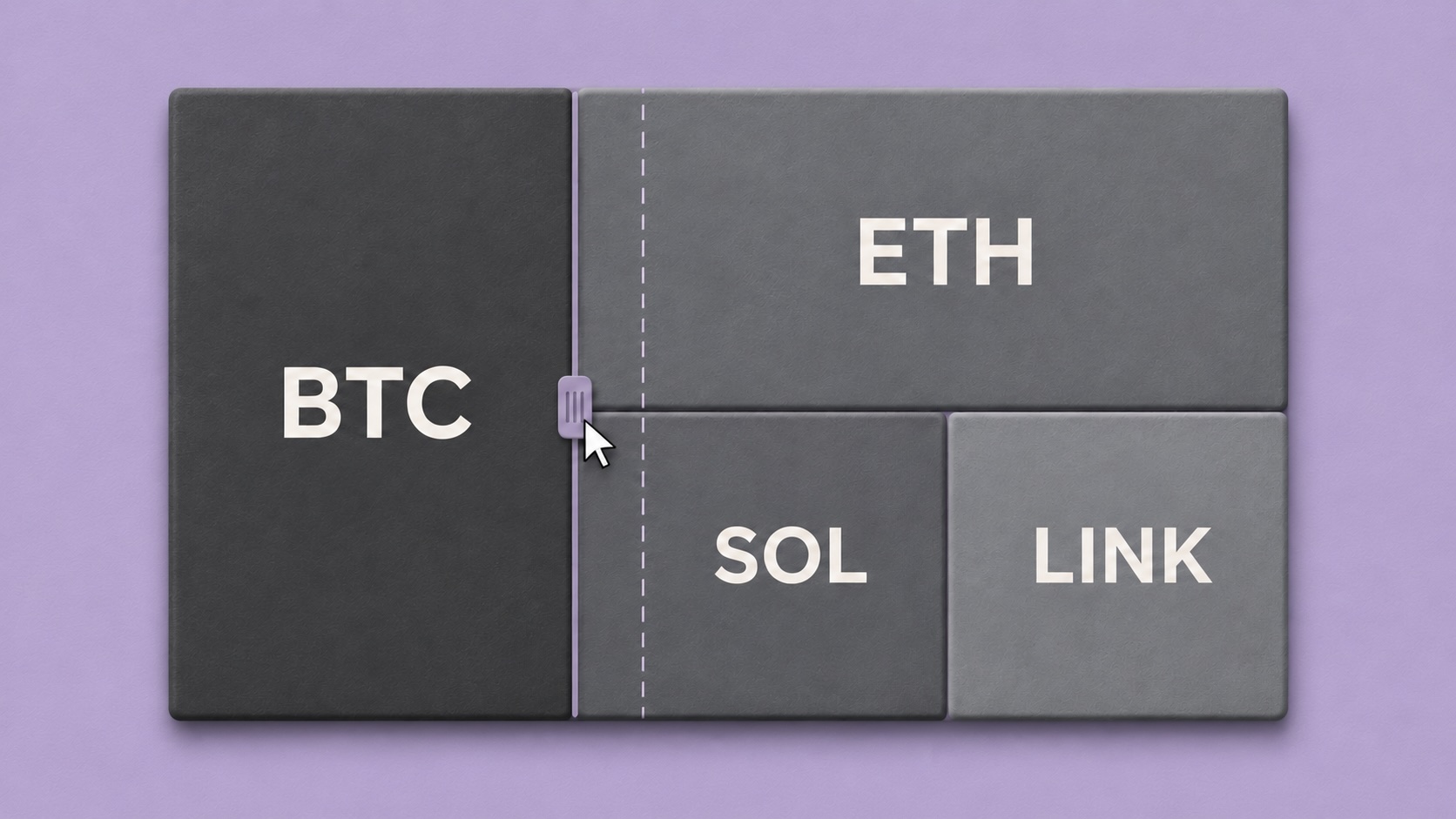
TL;DR: A crypto index you build yourself comes down to four choices: what goes in, how much of each coin, when you rebalance, and who actually presses the buttons. Most people get the second one wrong. Then they wonder why their "diversified" basket moves exactly like bitcoin.
"I want exposure to the whole market, not just one coin." I hear this a lot. And the standard answer is: buy an index fund.
Well, there's a caveat.
Take the biggest crypto index fund in the US, Bitwise's BITW. On 31 August 2026, 76.25% of it was bitcoin. Add Ethereum and you get 90.68%. So you pay for ten coins and mostly hold two.
If that's what you want, fine. But if you were hoping for a real spread across the market, you'll have to write the rules yourself. And then stick to them, which is the harder part. Let's go through it step by step, with real numbers, and see where a bot fits in.
Why Not Just Buy an Index Fund?
Here's what "the crypto market in one fund" looked like at the end of August 2026:

Source: Bitwise 10 Crypto Index ETF (BITW) fact sheet, holdings as of 31 August 2026
Look at the bottom of that chart. The six smallest holdings together make up 2.26% of the fund. Even if one of them doubles overnight, the index will barely notice. We're talking about a quarter of a percent.
Has this worked out for investors? Not really. Over eight calendar years, from 2018 to 2025, bitcoin beat the Bitwise 10 index in seven of them, according to Cryptoindex.ai research. In plain words, people took on the risk of nine altcoins and got less than plain bitcoin would have paid them.
That's the real reason to build your own index. Not to be clever. Just to decide for yourself what you actually own.
Step 1: What Goes Into the Basket?
Most people skip this step and just grab "the top 10." That's a choice too, and not always a smart one. A top 10 by market cap has a funny habit: a coin gets in only after it has already pumped, and drops out only after it has already crashed. You end up buying high and selling low, automatically.
There are other ways to draw the list. You can pick a sector, like AI tokens, DeFi or real-world assets, if you have a view on a theme (just keep in mind that some "sectors" are four illiquid coins in a costume). Or you can go with your own list of six to twelve picks. Full control, sure. But be honest with yourself: at that point it's a portfolio with rules, not a neutral benchmark.
Whatever you choose, three filters will save you a lot of pain later on.
- Throw out stablecoins. USDT and USDC sit near the top of every ranking. They don't grow, and they quietly dilute everything else.
- Keep only what your bot can trade. If the USDT pair is thin on your exchange, every rebalance will cost you in slippage.
- Don't count the same asset twice. Wrapped BTC or staked ETH tokens are just bitcoin and ether in a different jacket.
Need a starting point? You don't have to invent the rules from scratch. Cryptoindex.ai's methodology page publishes the universe, the formula and the data source for each of its baskets, from a broad top 100 to AI, DePIN and perp DEX indices. Take what works for you.
Step 2: How Much of Each Coin?
This is where most DIY indices quietly fail. Weighting decides whether the small coins can move the result at all. And that matters more than which coins you picked in the first place.
The classic option is market cap: every coin gets a share in proportion to its size. You stay close to bitcoin and trade very little. The opposite is equal weight, where every coin gets the same slice. That gives you real exposure to the smaller names, but you'll trade more. In between, you can cap market cap weights (say, no coin above 25%) or give more weight to calmer coins and less to the wild ones.
To show how big the difference really is, I took the ten coins that made up the Bitwise 10 index at the end of March 2026 and weighted them two ways.

Constituent returns and weights: Bitwise Crypto Market Review Q1 2026 (data as of 31 March 2026). Equal-weight and cap-weight figures calculated by us from those numbers.
So equal weight lost more. Why? Because in the first quarter of 2026 everything fell, and bitcoin fell the least of the ten. The basket that leaned on bitcoin simply held up better.
Now flip the market. In Q3 2026 Ethereum gained 69.1%, Solana 59.2% and Chainlink 97.6%, while bitcoin added 42.3% and the cap-weighted index 46.39%. When bitcoin trails its peers, it's the equal-weight basket that has the edge.
The main conclusion is simple. Equal weight is a bet that altcoins will beat bitcoin. Market cap is a bet that they won't. Neither one is "neutral." Pick the bet you actually believe in, and know that you picked it.
Step 3: When Do You Rebalance?
The moment you buy, your weights start to drift. A coin that doubles now takes up twice its share. One that halves shrinks to half. Rebalancing means trimming the winners and topping up the losers, so the basket goes back to the shape you designed.
In crypto the drift isn't small. Here's how differently the coins of one index behaved over five years:

Source: Bitwise Crypto Market Review Q1 2026. Sui, the tenth holding, had no five-year history. These are the index members as of March 2026, not five years earlier.
Solana up 322%. Polkadot down 97%. Same index, same five years. Without rebalancing, an equal-weight basket slowly turns into a portfolio of whatever happened to win, and stops being the index you built.
So when should you do it? There are two schools.
The first one is the calendar. Once a month or once a quarter, you bring every coin back to target. Bitwise, for example, rebalances its index monthly. It's simple to follow and simple to automate.
The second one is bands. You only trade when a coin drifts too far, for example 25% away from its target. With a 10% target that means acting below 7.5% or above 12.5%. In quiet markets you trade less, and when things get wild you react faster. A lot of people mix both: check once a month, trade only what's outside the band.
Just don't overdo it. Every trade pays a fee and a spread, and with ten or twenty coins that adds up fast. Plus, crypto trends. If you sell a coin every two weeks in the middle of a strong run, you cut off the very gains that made equal weight worth it.
Want a default for your first index? Monthly checks, 25% bands, and a membership review once a quarter. Boring? Yes. That's the point.
Step 4: Who Presses the Buttons?
Here's the honest truth about rebalancing. Writing the rules takes one evening. Following them for a year is where people fail.
Sell what's going up, buy what's going down, on schedule, through every crash and every rally... How long do you think you'll last? Most of us quietly stop after three months. A bot doesn't get bored, and it doesn't panic. So let's hand the routine over.
- Turn every rule into a number. Coins, target weights, band width, how often to check. If a rule sounds like "depends on the market," it's not ready yet.
- Connect your exchange with a limited API key. Trading on, withdrawals off. A non-custodial platform like Origami runs the strategy without ever holding your funds.
- Build the logic. The bot reads your balances, works out each coin's share, compares it with the target and the band, and places the orders that close the gap. With a strategy builder and a formula editor, "if the share is 25% above target, sell back to target" doesn't take a single line of code.
- Fund it gradually. Pair it with DCA, so new money goes to whatever is underweight first. Fewer sells, fewer fees.
- Run it in the cloud. Crypto never closes. A strategy on your laptop stops the moment you close the lid.
- Look at the stats. How much went to fees? How often did the bands fire? If the bot trades every couple of days, your bands are too tight.
One more thing before you go live: compare your basket with a published index that follows similar rules. Cryptoindex.ai's CI10 Blue Chip is an equal-weight top 10, and CI-15 is a cap-weighted top 15. If your bot drifts far away from its benchmark, something in the logic is off. You can also build and track a custom index powered by AI and test your rules before you put real money in.
What Usually Goes Wrong?
I've seen the same mistakes again and again, so here they are, in no particular order.
People rebalance way too often. Daily rebalancing in a market this volatile turns your bot into a machine for paying fees.
They forget about taxes. In many countries every rebalancing sale is a taxable event, and a strategy that looks great on a chart can look very different after tax.
They never review the list. Without a membership check, a coin that fell out of the top 20 two years ago is still sitting in your "top 10." Remember the chart above? Five of the nine coins lost more than two thirds of their value in five years.
They chase last month's winner. Adding a coin right after a 300% run is exactly how indices end up buying the top. Let the rules decide, not the headlines.
They trade thin pairs. On a small coin with a wide spread, one rebalance can eat more than the coin earns in a month.
And finally, they never compare. If you don't check your index against bitcoin and a public benchmark from time to time, how will you know your rules are working at all?
FAQ
Can I build my own crypto index?
Yes. Pick your coins, give each one a target weight and bring the portfolio back to those weights on a schedule, or whenever a coin drifts too far. A trading bot can do the rebalancing part for you.
Is an equal-weight or a market-cap crypto index better?
Neither one wins every year. Market cap keeps you close to bitcoin. Equal weight gives you real exposure to the smaller coins: great when altcoins outrun bitcoin, painful when they fall harder. In Q1 2026 the same ten coins lost 24.25% weighted by market cap and about 29.1% weighted equally.
How often should I rebalance a crypto portfolio?
For most people, once a month is enough, and only for coins that drifted more than about 25% away from target. Daily or weekly rebalancing usually costs more in fees than it brings back.
How many coins should a DIY crypto index have?
Enough to spread the risk, but not so many that trading gets expensive. For an automated basket, ten to twenty liquid coins is a sensible range.
Can a trading bot rebalance my crypto portfolio automatically?
Yes. The bot compares your current weights with the targets and places the trades that close the gap. Just use an API key with withdrawals switched off.
This article is for information only and is not investment advice.
함께 읽어보세요








Origami Tech와 함께하는 스마트한 트레이딩
강력한 자동 트레이딩 터미널로 암호화폐 거래 수준을 한 단계 높여보세요. 수익은 극대화하고 리스크는 최소화하며 24시간 내내 시장을 앞서 나가세요.