
TWAP vs VWAP vs Chase: Algorithmic Crypto Orders Explained
Introduction
Large crypto orders create an execution problem. A single Market order can consume several levels of the order book, while a static Limit order can fall behind as prices move. Algorithmic orders address this by controlling how an order is divided, timed, or repriced.
Three useful approaches are TWAP, VWAP, and Chase. TWAP spreads execution across time. VWAP weights execution using a volume profile. Chase keeps a working Limit order close to a changing market price.
This guide explains how the three methods differ and how they work in Origami Tech.
What Is Algorithmic Order Execution?
Algorithmic execution uses predefined rules to manage how an order reaches the market.
A larger instruction can be treated as a parent order and divided into smaller child orders. The algorithm determines when those child orders are submitted and how they are priced or sized.
Coinbase describes TWAP in the same way. Its official market rules state that a TWAP order splits a larger order into smaller pieces executed independently at different time intervals.
Coinbase also notes that a Market order can fill at several prices when available quantity at the best price is insufficient, creating slippage.
What Is a TWAP Order?
TWAP stands for Time Weighted Average Price.
A TWAP order divides a target quantity into smaller child orders and distributes them across a specified period.
For example, a $60,000 order executed over 30 minutes could be divided into six $10,000 child orders submitted every five minutes.
Coinbase describes TWAP as a method for reducing the market impact of large orders by splitting them into smaller increments executed at scheduled intervals.
TWAP can be useful when the order is large relative to visible liquidity, immediate completion has lower priority, and the trader wants execution spread across a defined period.
What Is a VWAP Order?
VWAP stands for Volume Weighted Average Price.
VWAP also divides a parent order into smaller executions, but the allocation is based on a volume profile rather than an even time schedule.
Coinbase Prime explains that its VWAP algorithm executes larger quantities during periods where its historical volume profile indicates greater liquidity and smaller quantities during lower volume periods.
What Is a Chase Order?
A Chase order manages a working Limit order relative to a changing reference price.
Imagine ETH has a best bid of $2,450. A trader places a Limit order at that price. If the best bid moves to $2,452, the static order remains at $2,450 until it is manually changed.
Chase automates that repricing process. The algorithm checks the market and can update the working Limit order according to predefined rules.
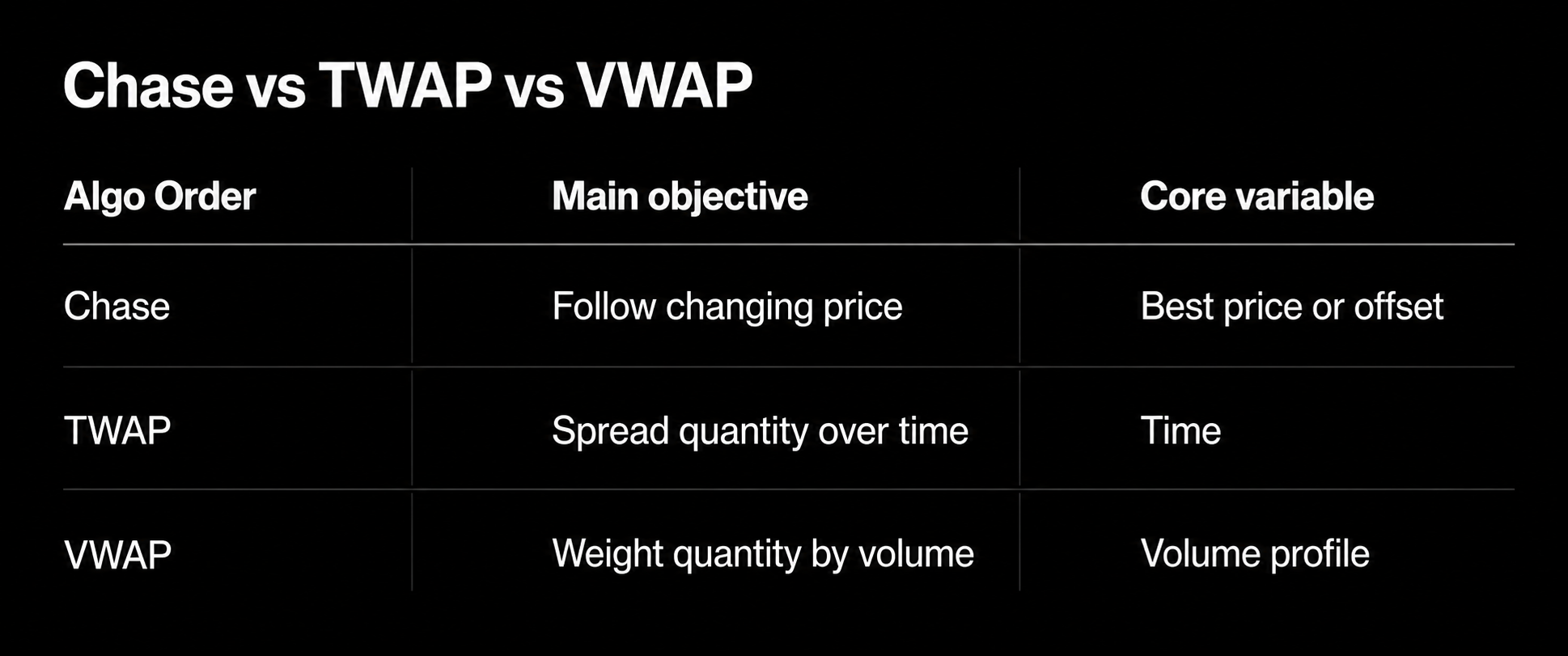
TWAP and VWAP distribute a parent order through multiple executions. Chase focuses on keeping a working Limit order aligned with a moving market price.
Algo Orders in Origami Tech
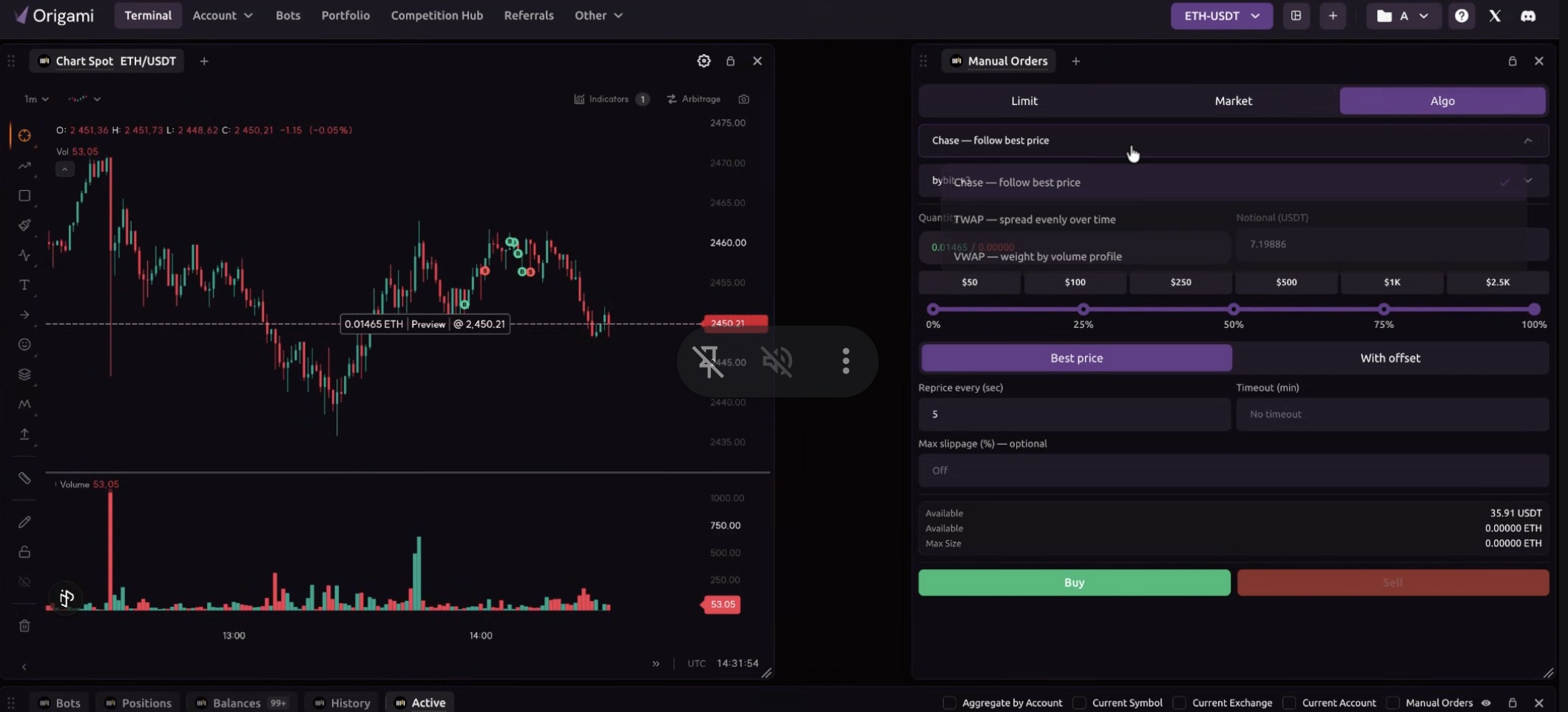
Origami Tech includes Chase, TWAP, and VWAP directly inside the Manual Orders widget of the crypto trading terminal.
Open Manual Orders, select Algo, and choose the required method.
How Chase Works in Origami Tech
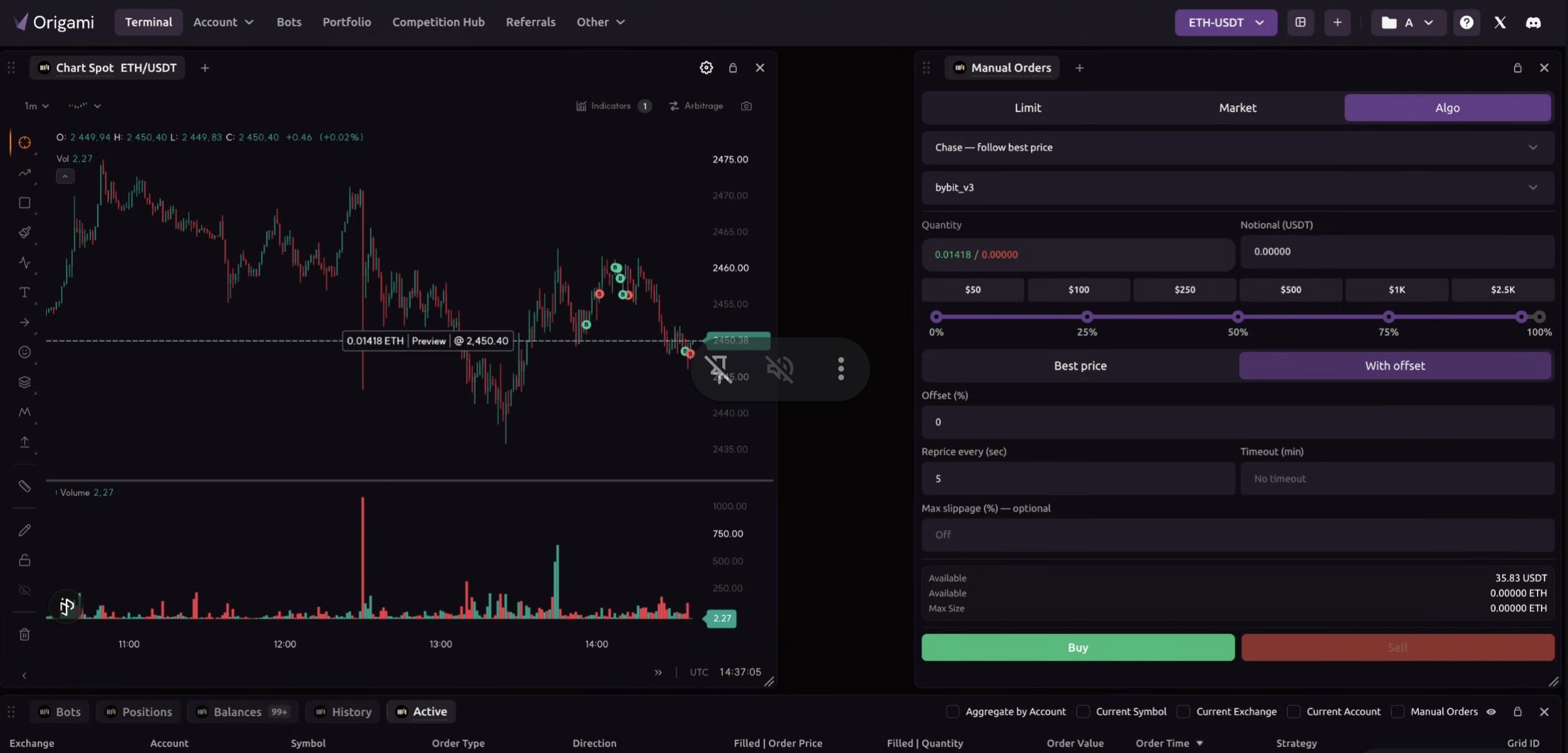
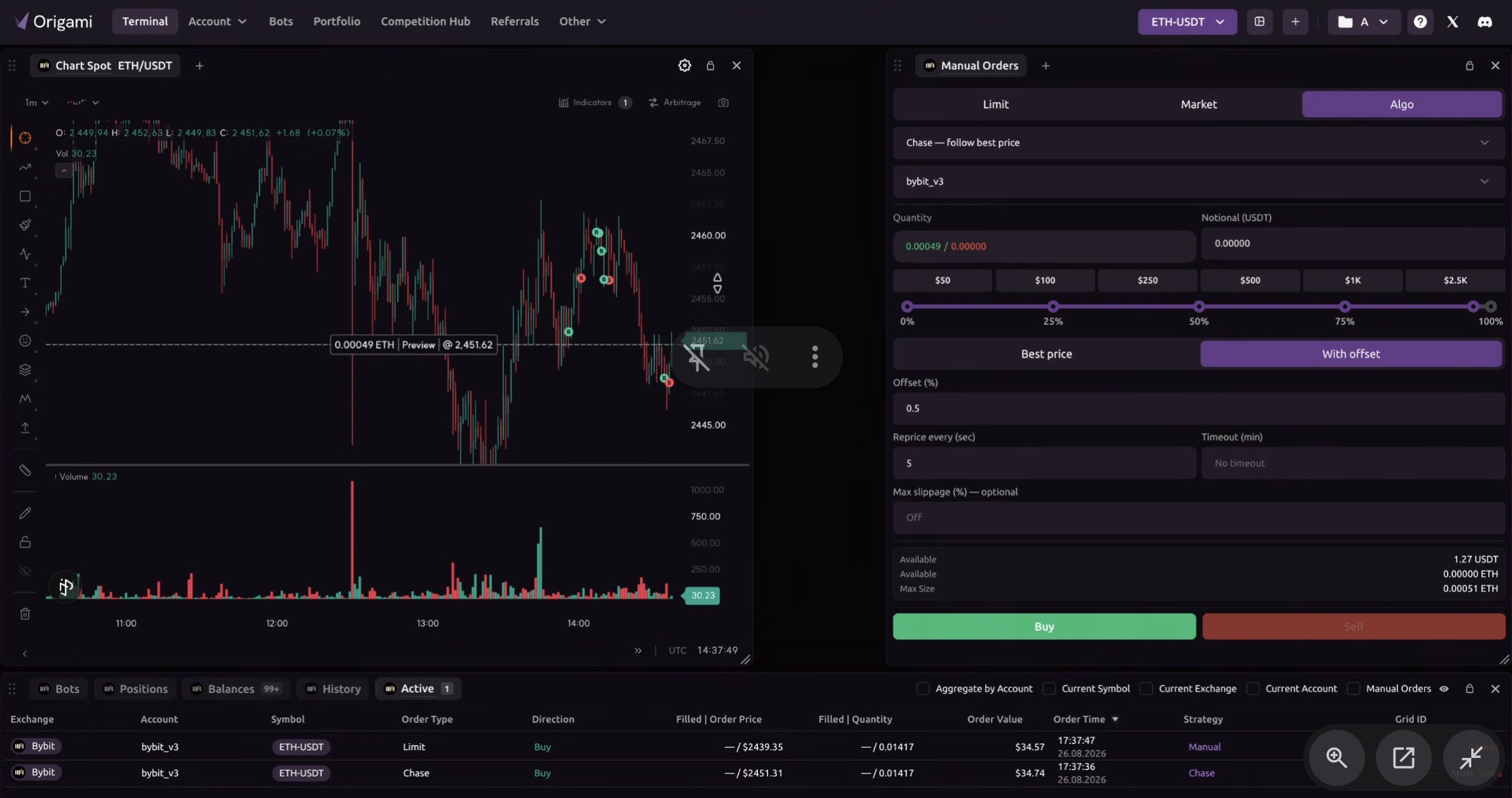
Origami Tech labels Chase as Chase, follow best price.
The user selects the account and quantity, then chooses one of two price modes:
Best price: follows the relevant best available price.
With offset: applies a percentage offset from the reference price.
Additional controls include:
Reprice every: defines how frequently Chase can evaluate and update the working order.
Timeout: sets the maximum duration. The interface also supports No timeout.
Max slippage: defines an optional slippage boundary.
After submission, Chase appears in Active Orders, where the order type, strategy, quantity, and execution status can be monitored.
How TWAP Works in Origami Tech
Origami Tech labels TWAP as TWAP, spread evenly over time.
The user defines the quantity, interval, duration, Market or Limit execution, and additional price or failure controls.
In the product example, a target purchase of 0.01257 ETH with a ten second interval and one minute duration is divided into six child orders of approximately 0.00209 ETH each.
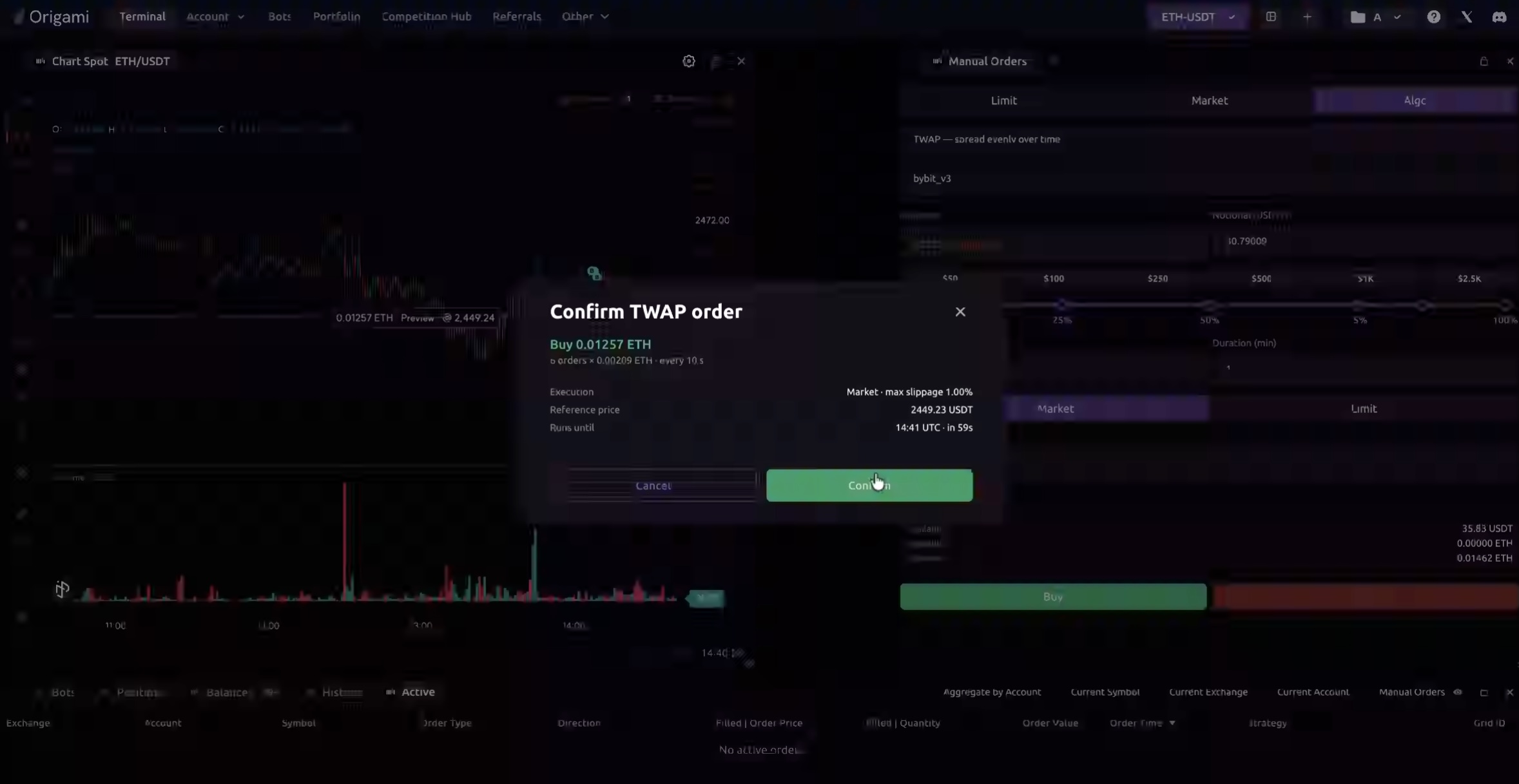
Use the Confirm TWAP order modal. It shows the total quantity, six child orders, ten second interval, execution method, reference price, and expected completion time.
Origami Tech also supports Limit execution within TWAP. With Limit selected, the interface provides a Price offset field.
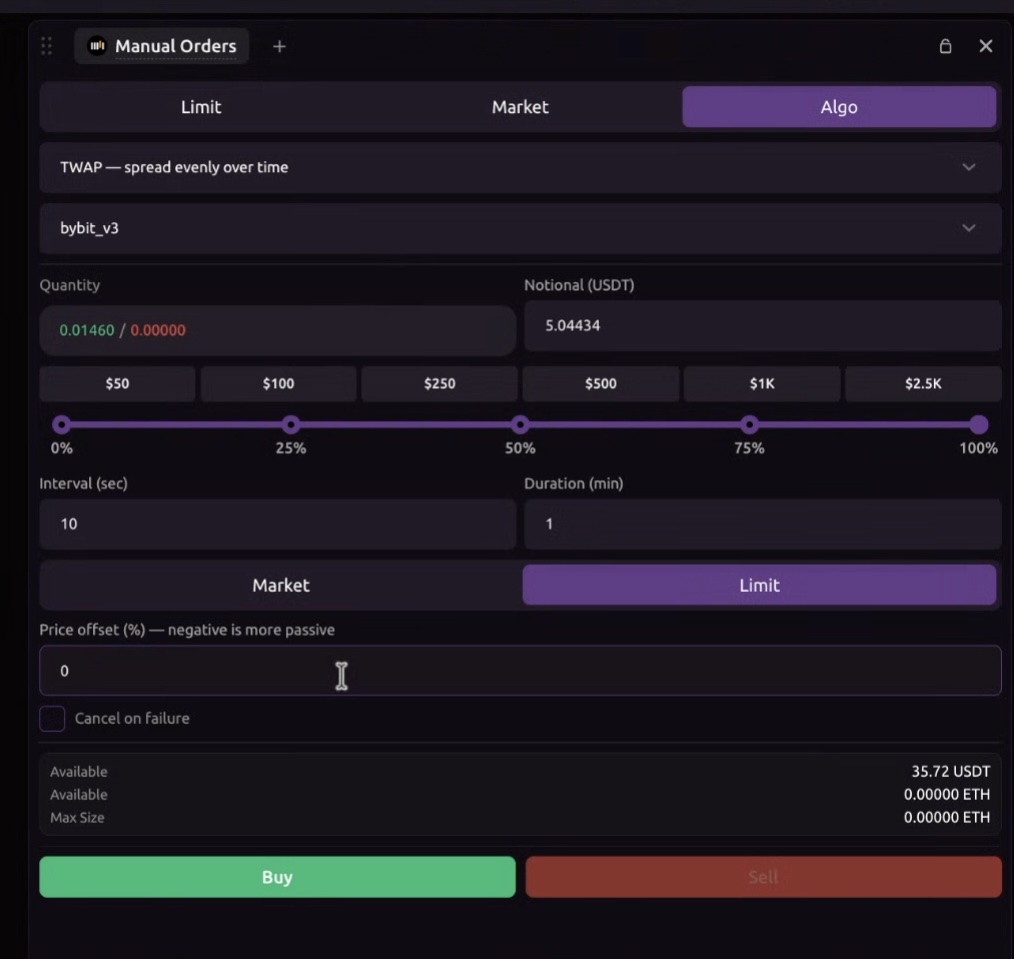
Cancel on Failure
Cancel on failure controls what happens when a child order fails.
With the option enabled, a failed execution can stop the remaining TWAP sequence. With it disabled, later child orders can continue according to schedule.
Monitoring TWAP in Active Orders
After confirmation, the TWAP parent order appears in Active Orders.
The interface shows filled quantity, order value, time, and strategy. Individual fills can also be seen on the chart. Active Algo Orders can be paused, resumed, or canceled from the same area.
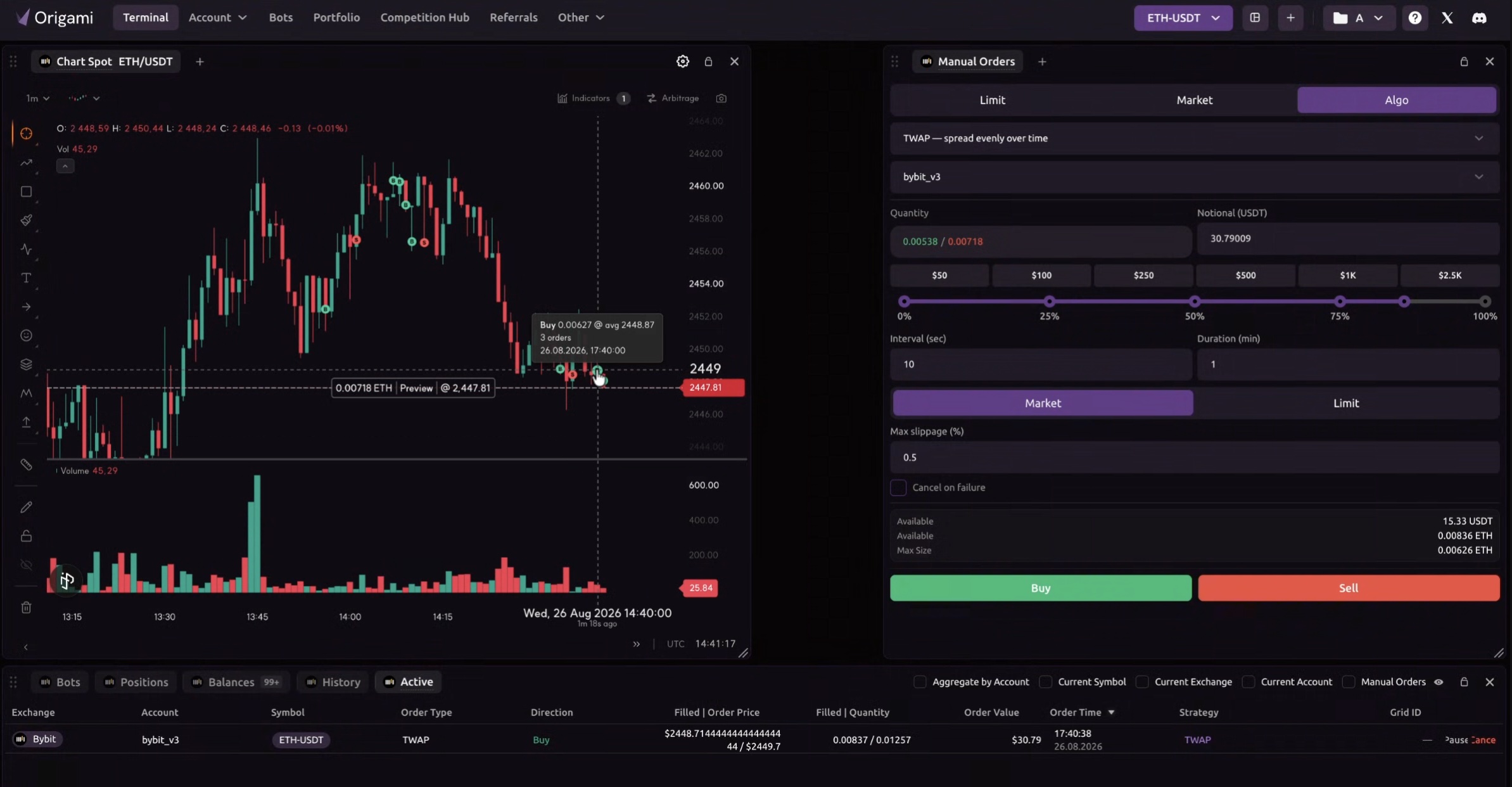
Use the terminal view with execution markers on the chart and the TWAP row in Active Orders. This screenshot clearly shows one parent order being executed through several smaller transactions.
How VWAP Works in Origami Tech
Origami Tech labels VWAP as VWAP, weight by volume profile.
The setup includes target quantity, interval, duration, Market or Limit execution, Max slippage, and Cancel on failure.
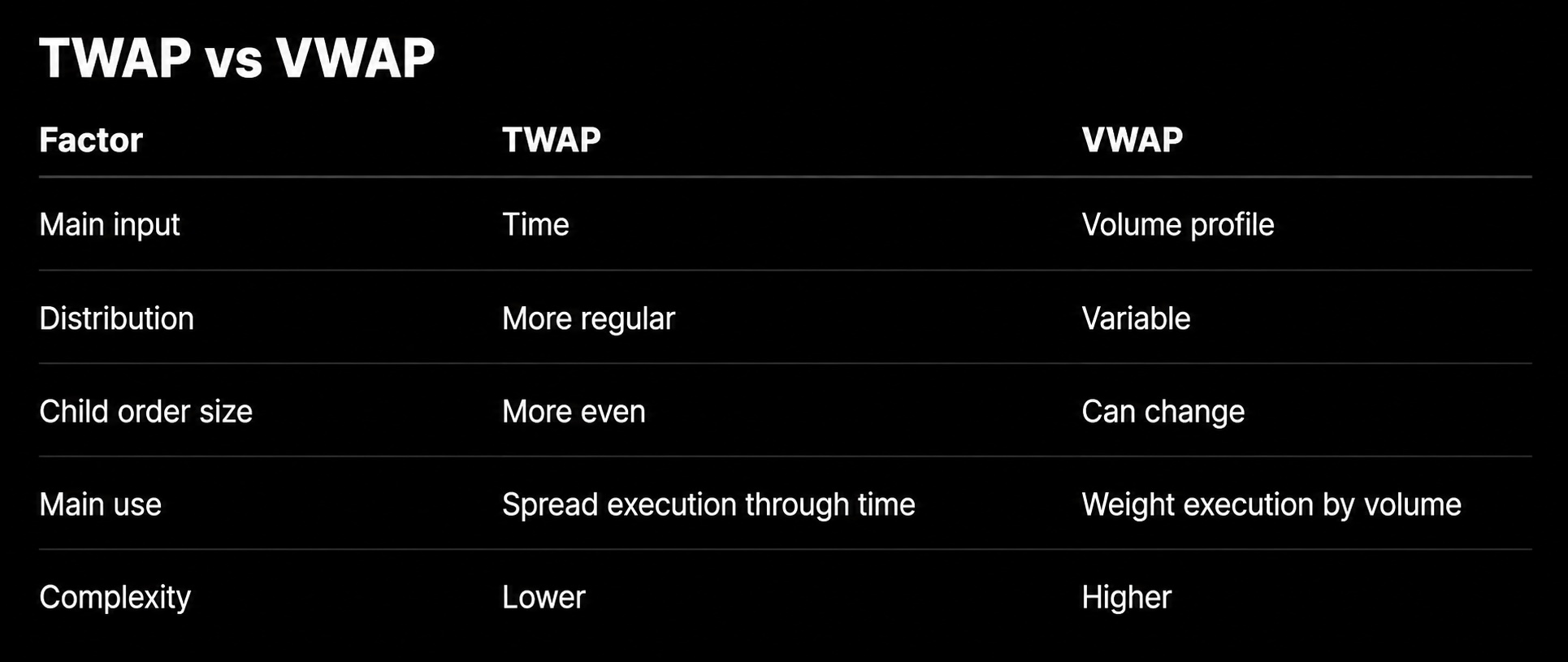
The key difference from TWAP is the weighting logic. TWAP spreads execution more evenly through time. VWAP uses a volume profile to influence how much of the parent order is executed during different intervals.
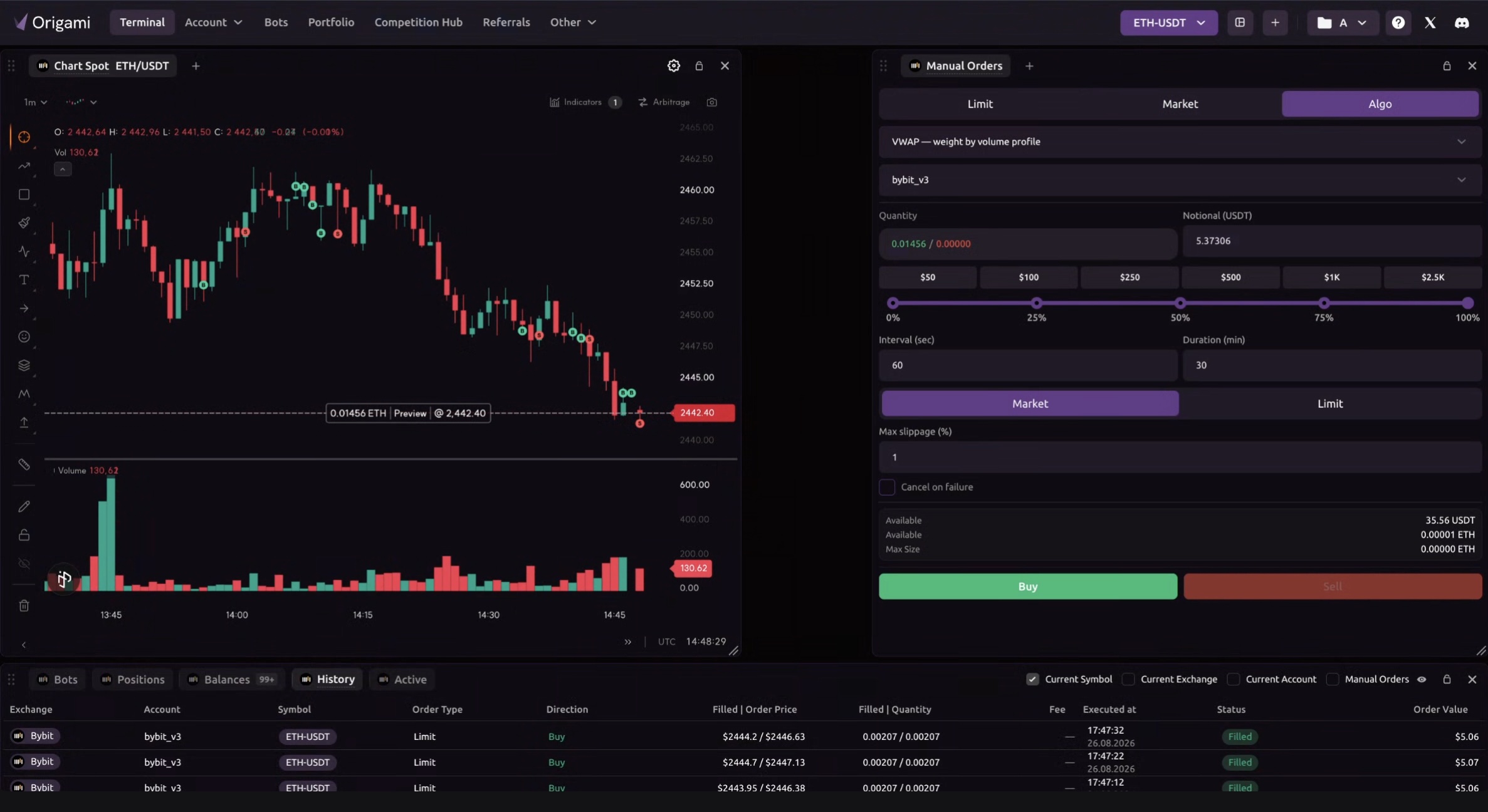
Use the full terminal crop with VWAP, weight by volume profile visible. Keep Interval, Duration, Market, Limit, Max slippage, and Cancel on failure readable.
Algo Orders vs a Crypto Trading Bot
Algo Orders and a crypto trading bot operate at different levels.
A crypto trading bot defines strategy logic. It can monitor market data, decide when conditions are met, determine quantity, and generate a buy or sell action.
An Algo Order manages how a specific execution reaches the market.
Origami Tech supports both layers within the same crypto trading bot platform, so automated crypto bot trading strategies and direct algorithmic execution can be managed within one workflow.
How to Choose Between TWAP, VWAP, and Chase
- Choose TWAP when a larger quantity should be distributed through a defined period with a relatively predictable schedule.
- Choose VWAP when execution weight should reflect a volume profile.
- Choose Chase when the main objective is keeping a working Limit order close to a changing market price.
The decision should also consider order size, liquidity, urgency, volatility, acceptable slippage, and execution duration.
Final Thoughts
TWAP, VWAP, and Chase solve three different execution problems.
TWAP spreads a parent order across time. VWAP weights execution using a volume profile. Chase dynamically manages a working Limit order as the market changes.
Origami Tech makes all three available inside Manual Orders. Users can configure the algorithm, review execution parameters, submit the order, and monitor progress through Active Orders alongside the rest of their crypto trading activity.
FAQ
What is the difference between TWAP and VWAP in crypto?
TWAP distributes execution primarily according to time. VWAP changes execution weight according to a volume profile.
What does a Chase order do?
A Chase order dynamically manages a working Limit order relative to a changing market price. In Origami Tech, it can follow the best price or apply a percentage offset.
Can TWAP use Limit orders?
Yes. Origami Tech allows Market or Limit execution for TWAP. Limit mode also provides a price offset setting.
Can Algo Orders be managed after launch?
Yes. Origami Tech allows active Algo Orders to be monitored and managed from Active Orders, including pause, resume, and cancel controls.
You may also like

See new Counter and Scaled Orders, mobile tools, Portfolio updates, and performance improvements across the Origami Tech crypto trading bot platform

Trade Smarter with Origami Tech
Take your crypto trading to the next level with our powerful automated trading terminal. Maximize profits, minimize risks, and stay ahead of the market 24/7.