
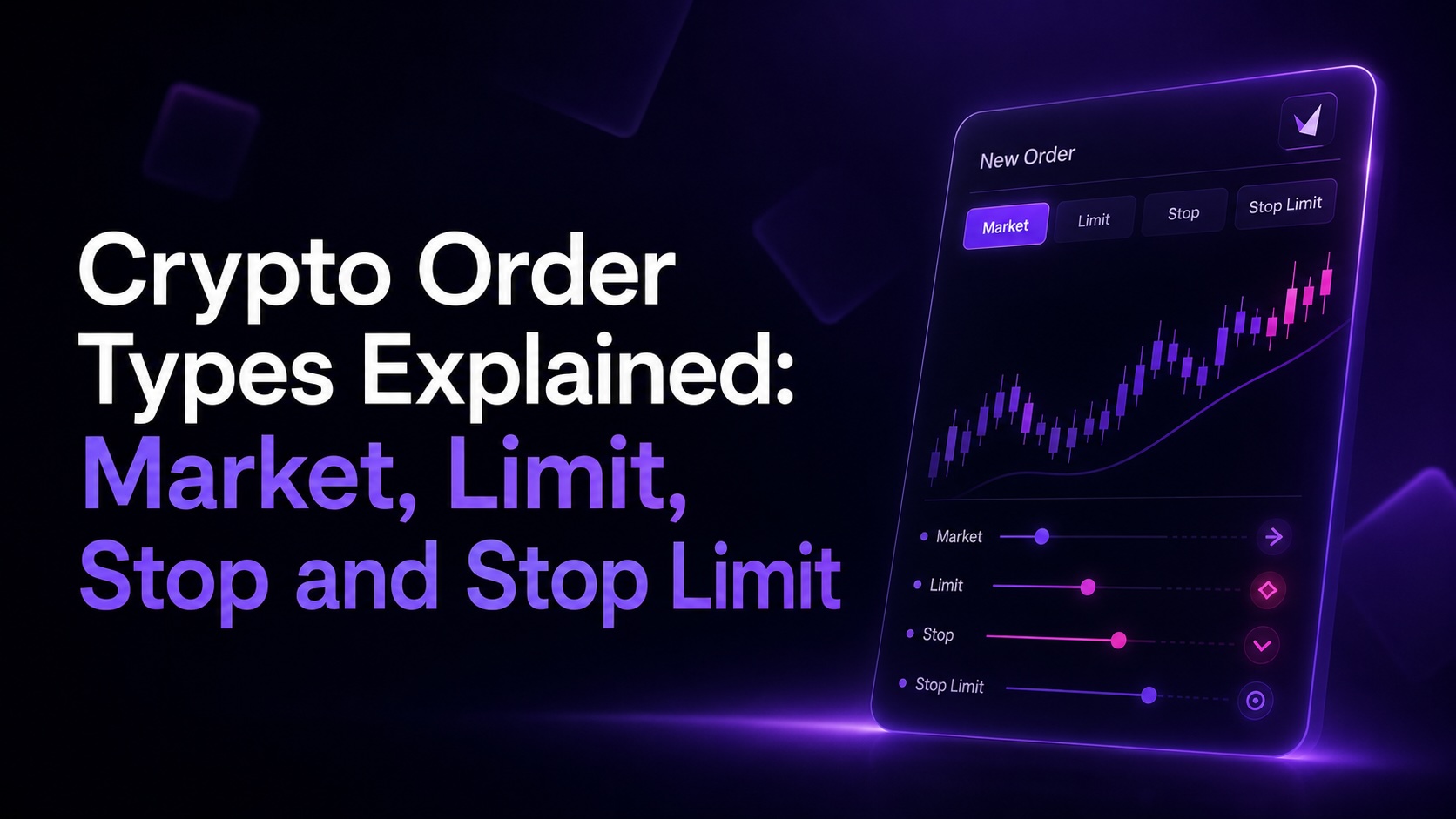
Crypto Order Types Explained: Market, Limit, Stop and Stop Limit
Introduction
Choosing the right order type is a basic part of crypto trading. An order tells an exchange how a buy or sell request should be executed. Market orders prioritize speed, limit orders prioritize price, and stop orders activate after a predefined trigger.
The differences matter most in volatile or low liquidity markets, where one order can move through several levels of the order book and execute at different prices.
This guide explains the main crypto order types, their execution risks, and how Market and Limit orders are used in Origami Tech.
What Is a Crypto Order?
A crypto order is an instruction sent to an exchange to buy or sell an asset under specified conditions. It usually includes the trading pair, direction, quantity, order type, and a price or trigger when required.
Investor.gov identifies market, limit, and stop orders as basic order categories. FINRA uses the same framework when explaining how order choice affects execution and price.
The same concepts are widely used by cryptocurrency exchanges. Coinbase documents Market, Limit, Stop and other execution methods in its official crypto trading rules.
An order is the instruction submitted to the market. A fill is the actual transaction. One order can produce one fill, several partial fills, or remain open while waiting for matching liquidity.
How a Crypto Order Book Works
An order book contains open buy and sell orders for a crypto pair.
The bid side contains buy orders. The ask side contains sell orders. The highest bid is the best bid, while the lowest ask is the best ask. The difference between them is the spread.
Suppose BTC has 0.05 BTC available at $100,000, another 0.10 BTC at $100,050, and 0.30 BTC at $100,100.
A market buy for 0.05 BTC may execute entirely at the first price. A market buy for 0.40 BTC needs liquidity from several levels and can therefore receive fills at different prices.
Coinbase explains that market orders may fill at multiple prices depending on order size and available liquidity.
Liquidity and Slippage
Liquidity describes how easily an asset can be bought or sold without materially affecting its price.
A deep order book contains significant volume close to the current price. A thin order book contains less available volume at each level.
Slippage is the difference between the expected execution price and the price actually received. Large order size, low liquidity, high volatility, wide spreads, and rapid changes in the order book can all increase it.
Kraken also notes that market order execution depends on available liquidity and order book depth.
What Is a Market Order in Crypto?
A market order tells the exchange to buy or sell using the best liquidity currently available. Its main priority is execution speed.
Investor.gov explains that market orders generally execute immediately, while the final price can differ from the quote visible when the order was submitted.
Market orders can be useful when fast execution matters, order size is small relative to available liquidity, or a position needs to be entered or closed quickly.
The main execution risk is slippage.
What Is a Limit Order in Crypto?
A limit order defines an acceptable execution price.
A buy limit order can execute at the specified price or lower. A sell limit order can execute at the specified price or higher.
Market Order vs Limit Order
A market order prioritizes speed. A limit order prioritizes price.
Market orders usually execute faster but provide less price control and greater exposure to slippage.
Limit orders provide a defined price boundary but can remain open or receive only a partial fill.
FINRA summarizes the tradeoff clearly: limit orders provide control over transaction price while creating the possibility that execution may never occur.
What Is a Stop Order in Crypto?
A stop order becomes active after the market reaches a predefined trigger price. A traditional stop order then becomes a market order.
Suppose an asset trades at $100 and a trader places a sell stop at $90. When the trigger is reached, the sell instruction activates. The actual execution price depends on liquidity available at that moment.
Investor.gov emphasizes that the stop price is a trigger rather than a guaranteed execution price.
A sell stop is usually placed below the current market price. A buy stop is usually placed above it.
With BTC at $100,000, for example, a sell stop could be set at $95,000 and a buy stop at $105,000.
Stop Price vs Execution Price
The stop price determines when an order activates. The execution price determines where the resulting transaction fills.
Imagine a sell stop at $90. During a fast market move, price falls from $92 to $86 with little liquidity between those levels.
The $90 trigger activates the order, while available bids may result in fills below $90.
This execution risk is one reason traders may consider a stop limit order.
What Is a Stop Limit Order?
A stop limit order combines two prices.
The stop price activates the order. The limit price defines the acceptable execution boundary.
Suppose an asset trades at $100. The trader sets a stop price at $90 and a limit price at $88.
When the market reaches $90, a limit sell order becomes active at $88.
This gives the trader more control over price after the trigger. Execution still depends on matching liquidity being available at the limit price or better.
A stop order prioritizes execution after the trigger. A stop limit order gives greater control over price while increasing the chance that the order remains unfilled.
What Is a Trailing Stop Order?
A trailing stop moves its trigger as the market moves favorably.
Instead of using one fixed stop price, the trader defines an offset as a percentage or fixed amount.
For example, a trader buys BTC at $100,000 and sets a trailing stop 5 percent below the market. If BTC rises, the trailing level can move higher with it. When the market later reverses enough to reach the trailing threshold, the stop activates.
Kraken describes trailing stops as orders that maintain a predefined offset while following favorable price movement.
Crypto Order Types in Origami Tech
Origami Tech includes direct order execution inside the Manual Orders section of its crypto trading terminal.
Users can choose Limit or Market depending on the execution objective. The same interface also contains an Algo category for advanced execution methods.

A trader who wants immediate execution can use Market. A trader with a specific acceptable price can use Limit.
Origami Tech also supports a broader crypto trading bot workflow. A crypto trading bot can determine when an order should be created, how much should be traded, and which conditions should trigger execution.
Advanced execution methods such as Chase, TWAP, and VWAP belong to a separate layer because they manage how orders are adjusted or distributed during execution.
How to Choose a Crypto Order Type
- Choose Market when execution speed is the main priority.
- Choose Limit when the acceptable price matters more than immediate execution.
- Choose Stop when an order should activate after a predefined price trigger.
- Choose Stop Limit when the trigger should also include a defined execution boundary.
- Choose Trailing Stop when the trigger should move with favorable price movement.
The appropriate choice also depends on liquidity, volatility, order size, and the rules of the selected exchange.
Final Thoughts
Market, limit, stop, and stop limit orders solve different execution problems.
A Market order prioritizes speed. A Limit order prioritizes price. A Stop order waits for a predefined trigger.
A Stop Limit order combines that trigger with additional price control. A Trailing Stop allows the trigger to move with favorable market movement.
Understanding these crypto order types becomes increasingly important as volatility, order size, or liquidity risk increases.
Advanced order instructions such as GTC, IOC, FOK, Post Only, Reduce Only, and Iceberg are covered separately. Algorithmic methods such as TWAP, VWAP, and Chase form another layer of execution by managing how orders are distributed or adjusted during execution.
FAQ
What are the main crypto order types?
Market, limit, stop, stop limit, trailing stop, and take profit are among the most common order types used in crypto trading.
What is the difference between a market order and a limit order?
A market order prioritizes execution speed. A limit order prioritizes price control.
Does a stop loss guarantee the stop price?
The stop price acts as a trigger. The final execution price depends on available liquidity when the resulting order reaches the market.
You may also like






Trade Smarter with Origami Tech
Take your crypto trading to the next level with our powerful automated trading terminal. Maximize profits, minimize risks, and stay ahead of the market 24/7.