
How to Use the Hyperliquid Price Spikes PNL Crypto Trading Bot in Origami Tech
Introduction
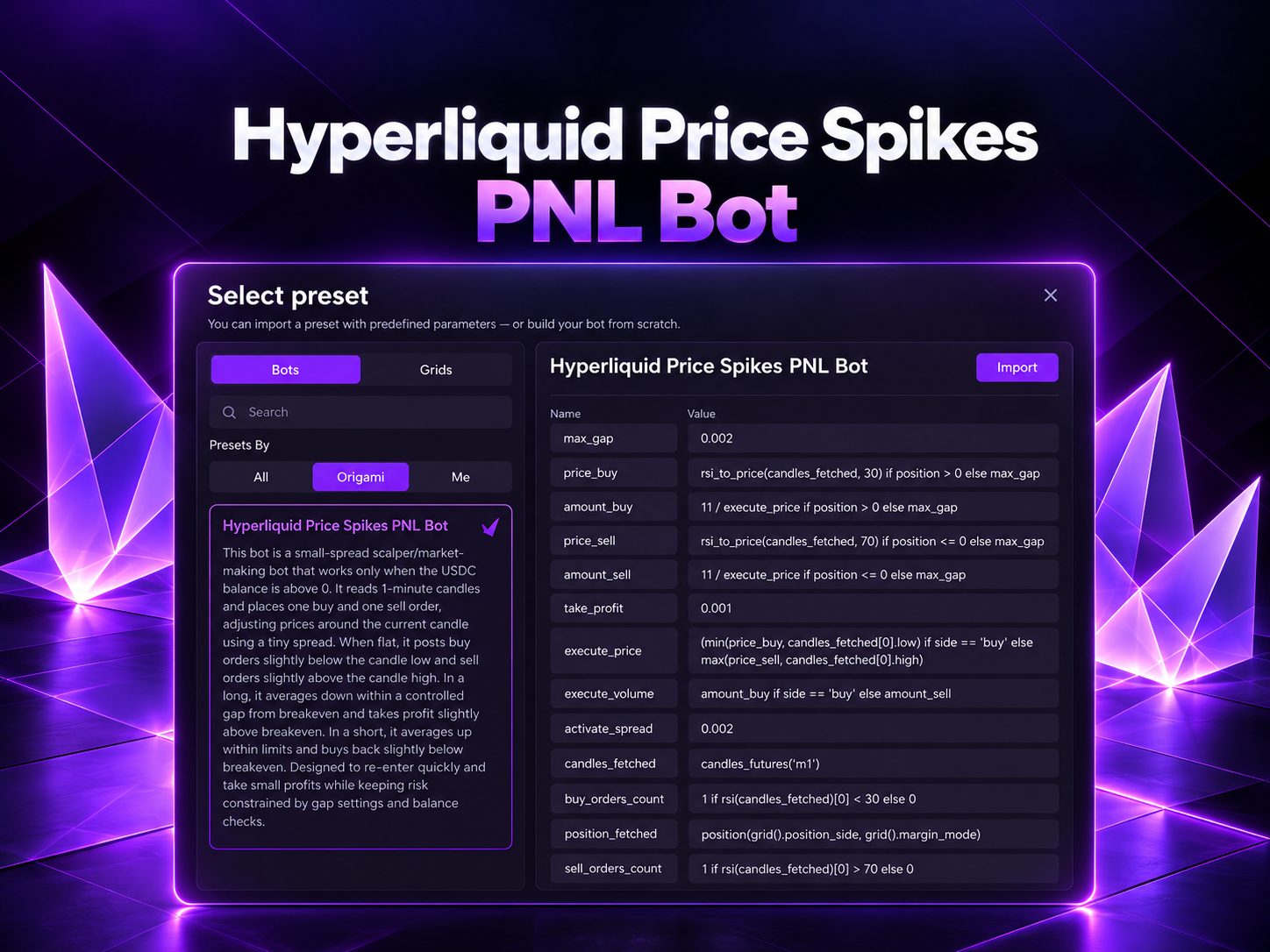
The Hyperliquid Price Spikes PNL Bot is an Origami Tech crypto trading bot preset designed for automated futures crypto trading on Hyperliquid.
The strategy combines one minute futures candles, RSI thresholds, dynamic RSI based price calculations, current position data and predefined execution limits. It can generate a buy when RSI moves below 30 and a sell when RSI moves above 70.
The preset is built around short term price extremes. Instead of using a fixed entry price, the crypto trading bot calculates target prices from current RSI conditions and recent candle data.
The default configuration uses:
- RSI 30 for buy conditions
- RSI 70 for sell conditions
- one minute futures candles
max_gap = 0.002, or 0.2%take_profit = 0.001, or 0.1%activate_spread = 0.002, or 0.2%- approximately 11 USDC of quote value in the visible order sizing formula
This guide explains how the preset works, what each formula does, which market conditions fit the strategy and which parameters can be adjusted.
What Is the Hyperliquid Price Spikes PNL Bot?
The Hyperliquid Price Spikes PNL Bot is an RSI driven crypto trading bot designed to react to short term price extremes.
The strategy watches one minute futures candles and calculates RSI continuously.
A buy condition becomes active when:
RSI < 30
A sell condition becomes active when:
RSI > 70
The bot then uses rsi_to_price() to translate those RSI thresholds into actual execution price levels.
This creates a strategy that combines an indicator signal with an executable market price.
The preset description positions the strategy as a small spread scalping and market making setup that can work around short term price spikes, manage an existing position and unwind exposure when necessary.
Who Can Use This Crypto Trading Bot?
The preset is most relevant for traders who already understand RSI and want to automate reactions to short term oversold and overbought conditions on Hyperliquid.
It can be useful for:
- short term futures crypto trading
- automated reactions to RSI extremes
- liquid markets with frequent intraday movement
- traders who want systematic entry rules instead of manually watching RSI
- strategies that require repeated small executions around temporary price dislocations
The crypto trading bot is particularly sensitive to short term market behavior because its default candle timeframe is one minute.
This means the strategy can respond faster than a setup based on fifteen minute or hourly RSI, while also becoming more exposed to short lived price noise.
How the Hyperliquid Price Spikes Bot Works
The core logic consists of four main components.
The bot reads current one minute futures candles.
It calculates RSI from those candles.
It converts RSI thresholds into price levels using rsi_to_price().
It uses the current position to determine which calculations are relevant for each side.
One Minute Futures Candles
The preset uses:
candles_fetched = candles_futures('m1')
The strategy therefore works with one minute futures candles.
These candles are used both for RSI calculations and for final execution price boundaries.
A one minute timeframe makes the strategy responsive to rapid price changes.
It also means that RSI can cross its thresholds more frequently than on longer timeframes.
Buy Signal
The default buy condition is:
buy_orders_count =
1 if rsi(candles_fetched)[0] < 30 else 0
The bot allows one buy order when the current RSI value falls below 30.
RSI below 30 is commonly interpreted as an oversold condition.
For this preset, the important point is mechanical: RSI below 30 activates the buy side.
The bot then calculates a corresponding buy price.
Sell Signal
The sell condition is:
sell_orders_count =
1 if rsi(candles_fetched)[0] > 70 else 0
The strategy allows one sell order when RSI rises above 70.
RSI above 70 represents the opposite extreme in the strategy.
The resulting logic is symmetrical:
RSI < 30 → buy side
RSI > 70 → sell side
RSI Based Buy Price
The default formula is:
price_buy =
rsi_to_price(candles_fetched, 30)
if position_fetched.available_quantity >= 0
else max_gap
The central function here is:
rsi_to_price(candles_fetched, 30)
Instead of simply waiting until RSI reaches 30 and then using the current market price, Origami Tech calculates the price level associated with the target RSI value.
This gives the crypto trading bot a price level that corresponds to RSI 30 under the current candle data.
The current position is also checked as part of the formula.
RSI Based Sell Price
The sell side uses:
price_sell =
rsi_to_price(candles_fetched, 70)
if position_fetched.available_quantity <= 0
else max_gap
The strategy therefore calculates the price corresponding to RSI 70 for the sell side.
Together, price_buy and price_sell allow the bot to translate indicator thresholds into executable price targets.
Current Position
The preset reads the current futures position through:
position_fetched =
position(grid().position_side, grid().margin_mode)
This allows the strategy to access the available position quantity and adjust calculations according to the current exposure.
The position condition used in price_buy and price_sell prevents the two directional calculations from being treated identically regardless of existing exposure.
Buy Amount
The visible preset formula is:
amount_buy =
11 / execute_price
if position_fetched.available_quantity >= 0
else max_gap
The number 11 defines the quote value used to calculate the amount of the base asset for the visible buy sizing logic.
For example, at an execution price of 2,000:
11 / 2000 = 0.0055
The resulting amount is approximately 0.0055 units of the base asset.
For a USDC quoted Hyperliquid futures market, this corresponds to approximately 11 USDC of notional value before execution differences and fees.
Sell Amount
The visible sell formula follows the same structure:
amount_sell =
11 / execute_price
if position_fetched.available_quantity <= 0
else max_gap
The quote value in the visible default configuration is therefore also 11.
This keeps the basic order sizing symmetrical between the two directions.
Important Note About the Preset Description
The description shown inside Origami Tech currently says that the strategy uses a small $100 probe when flat.
The visible formulas in the same preset currently use:
11 / execute_price
These two values differ.
For the numerical examples in this guide, the current visible formula is used as the source of truth. The description should be updated if the intended default has permanently changed from 100 to 11.
Maximum Gap
The preset defines:
max_gap = 0.002
This corresponds to:
0.2%
The variable appears as the alternative value inside several conditional formulas.
The preset description also refers to controlled averaging within a defined gap around the position.
A smaller max_gap creates a tighter limit.
A larger value allows a wider distance.
Because the exact breakeven formula described in the preset text is not visible in the current parameter list, max_gap should be treated as an advanced strategy parameter and changed carefully.
Take Profit
Default:
take_profit = 0.001
This equals:
0.1%
The preset description states that profitable positions can be closed slightly beyond breakeven.
The visible parameter list includes the take_profit value, while the final displayed execution formula does not explicitly show where this value is applied.
The parameter therefore belongs to the intended PNL management logic of the preset, while its complete downstream calculation is not visible in the current preset summary.
Activate Spread
The preset also contains:
activate_spread = 0.002
This corresponds to:
0.2%
The setting defines another spread threshold available to the strategy.
The preset description characterizes the bot as a small spread scalping and market making strategy, making this parameter relevant to how the strategy handles price distance and activation conditions.
The visible summary does not expose a formula directly referencing activate_spread, so changes to this value should be tested before production use.
Final Execution Price
One of the most important formulas is:
execute_price =
min(price_buy, candles_fetched[0].low)
if side == 'buy'
else
max(price_sell, candles_fetched[0].high)
This introduces an additional price boundary based on the latest one minute candle.
For a buy, the bot chooses the lower value between:
price_buy
and:
current candle low
For a sell, it chooses the higher value between:
price_sell
and:
current candle high
This means RSI alone does not determine the final execution price.
Recent market structure from the current candle also affects where the order is placed.
Buy Example
Assume:
RSI based buy price = 100
Current candle low = 99.8
The formula calculates:
min(100, 99.8) = 99.8
The resulting execution price is 99.8.
Sell Example
Assume:
RSI based sell price = 101
Current candle high = 101.4
The formula becomes:
max(101, 101.4) = 101.4
The sell execution price becomes 101.4.
This structure pushes the buy side toward the lower boundary and the sell side toward the higher boundary of the current market move.
Execution Volume
The final volume selection is:
execute_volume =
amount_buy if side == 'buy' else amount_sell
The selected order direction therefore determines which amount formula is used.
The default visible formulas use a quote value of 11 divided by the current execution price.
Default Hyperliquid Price Spikes Bot Parameters

What Happens During a Typical Buy Setup?
Assume RSI on the one minute futures candles falls to:
RSI = 27
The buy condition becomes active because:
27 < 30
The bot calculates:
rsi_to_price(candles_fetched, 30)
Suppose the resulting price is:
100.20
The current candle low is:
99.90
The execution formula selects:
min(100.20, 99.90)
which produces:
99.90
The approximate visible default order amount becomes:
11 / 99.90 ≈ 0.1101
The crypto trading bot can therefore place one buy order using the calculated price and volume.
What Happens During a Sell Setup?
Suppose RSI rises to:
RSI = 74
The sell condition passes because:
74 > 70
The strategy calculates an RSI based sell price using:
rsi_to_price(candles_fetched, 70)
Suppose that value equals:
100.80
and the current candle high is:
101.10
The execution formula chooses:
max(100.80, 101.10)
which gives:
101.10
The sell order is therefore placed using the higher price boundary.
Which Markets Are Suitable for This Crypto Trading Bot?
This preset is specifically designed around Hyperliquid futures data.
Its logic is best evaluated on markets with:
- sufficient perpetual futures liquidity
- reliable one minute candle data
- frequent intraday price movement
- enough order book depth for repeated small orders
- spreads compatible with short term execution
- manageable fees relative to the targeted price movement
Markets with regular short term oscillations provide more opportunities for RSI to move between oversold and overbought regions.
Strong directional markets deserve additional attention.
RSI can remain below 30 or above 70 for extended periods during powerful trends. An RSI threshold therefore indicates a market condition rather than guaranteeing an immediate reversal.
How to Launch the Hyperliquid Price Spikes Crypto Trading Bot
- Open your Origami Tech project and connect the Hyperliquid account used for futures crypto trading.
- Create a new crypto trading bot for the selected Hyperliquid perpetual futures pair.
- Review the required position mode, margin configuration and account balance.
- Open the preset selector and choose: Hyperliquid Price Spikes PNL Bot
- Review the imported parameters before activation.
- The most important settings to check are:
max_gap
take_profit
activate_spread
RSI thresholds
order sizing
candle timeframe
7. Save the crypto trading bot after reviewing the formulas and activate it when the configuration matches your intended strategy and risk limits.
Which Parameters Should You Change?
RSI Buy Threshold
Default:
30
This value controls when the buy side becomes active.
A lower threshold, for example:
25
requires a more extreme RSI decline before allowing a buy.
This usually creates fewer buy signals.
A higher threshold, for example:
35
allows the strategy to react sooner and can produce more frequent buy signals.
Changing this value also requires changing the corresponding target in:
rsi_to_price(candles_fetched, 30)
if you want the signal threshold and calculated execution price to remain aligned.
RSI Sell Threshold
Default:
70
A higher value such as:
75
requires a stronger overbought condition before generating a sell signal.
A lower threshold such as:
65
creates more frequent sell signals.
The corresponding rsi_to_price() target should be reviewed together with the order trigger.
Order Size
Current visible formula:
11 / execute_price
Increasing 11 increases the quote value of each order.
For example:
25 / execute_price
would approximately double the current visible notional size.
Smaller order values reduce exposure per signal.
Larger values create more exposure each time an RSI condition is triggered.
max_gap
Default:
0.002
or 0.2%.
This parameter belongs to the preset's controlled gap logic.
A smaller value creates a tighter allowed gap.
A larger value expands it.
Traders modifying this setting should review how it interacts with open positions and the preset's intended averaging behavior.
take_profit
Default:
0.001
or 0.1%.
Increasing the value requires a larger favorable move before reaching the configured profit distance.
Reducing it brings the profit target closer.
Small profit targets should always be evaluated after Hyperliquid trading fees and execution costs.
activate_spread
Default:
0.002
or 0.2%.
A smaller value creates a tighter spread condition for the parts of the strategy that use this variable.
A larger value makes the spread filter more permissive.
Because the visible preset summary does not show the final formula consuming this variable, changes should be tested rather than treated as a simple execution frequency adjustment.
Candle Timeframe
Default:
candles_futures('m1')
A longer timeframe would fundamentally change RSI behavior.
For example, RSI calculated from five minute candles will react differently from RSI based on one minute candles.
A longer timeframe generally creates slower signals and filters more short term noise.
Changing the timeframe therefore represents a significant strategy modification.
Which Parameters Form the Core Strategy Logic?
The following formulas define the structure of the crypto trading bot:
price_buy
price_sell
execute_price
execute_volume
buy_orders_count
sell_orders_count
position_fetched
Changes to these formulas alter how signals are translated into actual futures orders.
Adjusting RSI thresholds or order size is comparatively straightforward.
Changing execute_price or the position conditions effectively creates a different crypto bot trading strategy.
How to Make the Bot More Selective
A more selective configuration can use:
- a lower RSI threshold for buys
- a higher RSI threshold for sells
- smaller order size
- more restrictive gap and spread parameters
- a longer candle timeframe
This reduces the number of situations in which the strategy becomes active.
The tradeoff is fewer crypto trading opportunities.
How to Make the Bot More Active
A more active configuration can use:
- a higher buy RSI threshold
- a lower sell RSI threshold
- the existing one minute timeframe
- larger acceptable execution ranges
- larger order sizing when account risk limits allow it
Such settings increase the number of potential signals and total crypto trading activity.
Fees, liquidity and false RSI signals become more important as execution frequency increases.
What to Monitor After Launch
The most important metrics are:
- current RSI
- order count
- average execution price
- current position
- position notional
- realized PnL
- unrealized PnL
- trading fees
- funding
- frequency of RSI 30 and RSI 70 signals
Execution prices also deserve attention because the strategy combines RSI derived prices with one minute candle highs and lows.
A change in volatility can therefore materially change the distance between generated orders.
Main Risks of the Hyperliquid Price Spikes Bot
RSI based strategies rely on the assumption that extreme short term moves can create useful entry or exit conditions.
Strong trends can keep RSI in extreme territory for longer than expected.
A price can therefore continue falling after RSI moves below 30 or continue rising after RSI exceeds 70.
Futures crypto trading also introduces leverage, margin, funding and liquidation risks.
Small profit targets make trading fees particularly important.
Position size and total exposure should therefore be monitored together with the indicator logic.
Final Thoughts
The Hyperliquid Price Spikes PNL Bot combines short term RSI signals with dynamic price calculation and current futures candle boundaries.
The default strategy uses:
RSI < 30
for buy signals and:
RSI > 70
for sell signals.
It calculates execution levels using rsi_to_price(), one minute candle highs and lows and current position information.
The default visible parameters include a 0.2% max gap, 0.1% take profit, 0.2% activate spread and a current visible sizing formula based on approximately 11 USDC of quote value per order.
The most practical settings to review are RSI thresholds, order size, max_gap, take_profit, activate_spread and candle timeframe.
More extensive changes to execute_price, position conditions or order count formulas should be treated as modifications to the underlying crypto trading bot strategy.
General disclaimer: Futures crypto trading involves market, leverage, liquidation, funding, fee and execution risks. RSI based signals do not guarantee price reversals. Crypto trading bot presets automate predefined strategy logic and do not guarantee profitability or future crypto trading bot returns.
You may also like






Trade Smarter with Origami Tech
Take your crypto trading to the next level with our powerful automated trading terminal. Maximize profits, minimize risks, and stay ahead of the market 24/7.